
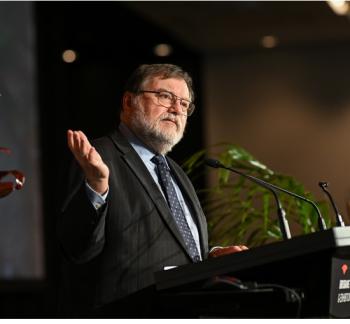
On Monday 13 October, Prof Haymet delivered a speech at the 2025 International Data Week Conference in Brisbane.
Good morning, everyone, and thank you.
I’m very pleased to be at this historic conference: the first of its kind in Australia and Oceania, and one that is held on Aboriginal land.
So let me join with Rosie and acknowledge the traditional custodians of this land and pay my respects to their Elders. More than respects; on the third of November I will join with the Prime Minister and the Minister for Science when they award the Prime Minister’s first prize for Aboriginal and Torres Strait Islander Knowledge Systems. The third of November will be a big day!
I am pleased this conference has a special focus on discussions regarding First Nations data, and I will talk more about that in this speech.
***
So, we’ve all made a journey to be here – some longer than others – and I especially welcome our international guests.
We’re also all on journeys in our careers and, along the way, scientific partners come and go, helping us to navigate the road.
But one partner has stayed with me since university – not just a companion, but a guiding light, and that is respect for the data.
Throughout my professional life, data has so often been the bedrock of my work. Today I want to speak with you about its power, its governance, and the tools, skills and infrastructure that will underpin it in the years ahead.
***
What you do matters – now more than ever.
You’re not just managing data, you’re enabling discovery. And in a very efficient manner.
You’re helping researchers push boundaries, solve problems faster, and break through barriers that once held them back.
You do this because you understand the value of knowledge, and you understand how data can build that knowledge and address significant problems.
You might not be the ones directly addressing those problems – like climate change or curing diseases. But you are the ones making that work possible – because those global challenges rely on data.
***
Like me, I suspect many of you started in research.
Like me, many of you earned PhDs, and studied deeply in your disciplines.
But somewhere along the way, like me, you got hooked – not just on the science, but on the data itself.
You saw its potential, its future use, how it could be managed, structured, unlocked, and used.
And now, you stand at a unique intersection. You understand the science, and you understand the data systems relating to it.
And that makes you uniquely important at this point in history.
I want to spotlight others as well, and acknowledge the organisations behind this conference:
• the International Science Council’s Committee on Data
• the World Data System
• and the Research Data Alliance.
I also thank the Australian Research Data Commons for hosting this event here in Australia.
The ARDC, as it’s known, is more than infrastructure.
To me, it's a national enabler of smarter, faster and more connected research – in Australia and globally.
Indeed, when data is shared across borders, it accelerates discovery and deepens insight. The data becomes more than a resource – it turns into a force multiplier at a global level.
Conferences like this foster that collaboration and spotlight best practices when it comes to data management.
And on that front, the ARDC has much to be proud of.
I understand The Digital Research Alliance of Canada is evaluating the ARDC digital skills framework. That framework will inform Canada’s national workforce strategy in digital research
I also note Australia’s stewardship of the Research Activity Identifier – known as RAID. It’s now being adopted locally and in Europe.
RAID has been described as a digital passport for research projects. It gives each project a unique and persistent ID. That ID links people, data, institutions, and outcomes – all in one place.
***
I want to shift focus now and talk about public data and how it’s gathered, managed, shared and used.
Having worked for some years in data-intensive research, I now find myself in a data-focused role of a different kind.
As Chief Scientist, I’m a member of the National Data Advisory Council that supports the work of the National Data Commissioner.
I congratulate our recently retired National Data Commissioner Gayle Milnes and their team on the work they are doing.
The council, chaired by Rod Sims, well known to Australians here, provides advice on issues relating to privacy, data protection, the ethics of data sharing, community expectations, and technical best practice.
A number of my remarks today are informed by my association with the National Data Commissioner and members of the council including Associate Professor Kalinda Griffiths and Professor Peter Leonard.
Kalinda has particular expertise regarding First Nations data and has already taught me a lot. And Peter is a technology and data expert, and lawyer, of many years standing.
Coincidentally, Peter and I went to high school together 300 years ago.
My work on the council has shown me how fortunate we are in Australia to have good foundations in place when it comes to the use of public data – that is, information collected, generated and curated by the Australian Government.
I am talking here about de-identified data – data that doesn’t identify individuals but does provide over-arching insights to help deliver better services to our community.
Just by way of context … three years ago, the Data Availability and Transparency Act was set up. It helps unlock the value of public data in this country – safely, responsibly and for the benefit of all Australians.
The act has supported the secure sharing of data between government and a trusted community of accredited researchers. It has helped to shift the mindset from ‘data as a risk to ‘data as a resource’. A resource that is responsibly shared and used for the public good. It was a good act, with a sunset clause, and a lot of fine people are working to make the next version even better.
Fortunately, we have strong data platforms and governance in Australia, and strong legal frameworks to protect personal privacy.
Plus, there is a public awareness that the analysis of de-identified data can help deliver better services that help our communities.
Community support is crucial, because evidence-based decision-making will be increasingly driven by data-linkage projects. In particular, those involving large data-sets of public sector data and, where appropriate, private sector data as well.
So, our laws mean we have strong oversight regarding safe data use. But not all data should be shared the same way. Some needs tight governance; some can be more open.
I know today’s sessions will explore First Nations data. And I commend the conference organisers for creating spaces for these critical conversations.
The National Data Advisory Council has a particular focus on issues including ethical data governance and Indigenous data sovereignty measures. Many of you know some of the activities happening in Geraldton. As scientists and people working with data, we must place an increasingly high priority on those issues.
I am pleased that Australian Government agencies have developed a landmark Framework for Governance of Indigenous Data.
It was designed in partnership with Aboriginal and Torres Strait Islander peoples. And it says they must be involved at every stage of the data process – in data collection, storage, use, and sharing.
The framework was published last year and there is a seven-year plan for government to fully implement all the actions.
Programs like this framework reflect growing awareness – in the community, government and in science – about Indigenous data sovereignty. And about the need to embed Indigenous governance, ethics and knowledge systems into the core of data and research practice.
***
Finally, these wonderful new data processing tools also demand new infrastructure.
Last year, Australia took a significant step forward with the release of the National Digital Research Infrastructure Strategy.
The strategy reflects the central role of digital research infrastructure when it comes to scientific discovery.
That infrastructure can be wide-ranging. For example, it can include data generated for, and through, research plus the highly-skilled workforce that can interpret the data.
The infrastructure can also include advanced computing, smarter software, and systems that are very secure and very scalable.
The strategy charts a course for infrastructure that integrates computing and data.
It is a course underpinned by strong training frameworks – because infrastructure is only as powerful as the people who use it.
And it charts a course that supports science through openly available research software tools.
***
By providing more open access to data, and scientific knowledge, we can accelerate innovation.
By unlocking data and research, we enable collaboration across disciplines. That can support small businesses, startups, researchers – you name it!
It can also help to support evidence-based policy decisions.
***
Let me close with this: when the world faces complex problems, data is almost always part of the solution.
In science, it remains our guiding light that illuminates the path ahead. A light that helps us to understand the challenges we face and to uncover the solutions within our grasp.
That’s why it’s vital to reflect on how data is governed and used, and to invest in the tools and skills that help us use it wisely.
I hope my comments today support your conversations about the future of data and how it can continue to serve the public good.
Thank you.