
On 15 May 2026, Prof Tony Haymet delivered the opening remarks for the 9th Malaspina Awards ceremony and later presented the Individual Award to Dr Josep 'Pep' Canadell.
Welcome everyone – this is such an important event and in one of our favourite buildings.
Let me add my acknowledgement to the Traditional Owners of the land on which we meet today, the Ngunnawal people.
I pay my respects to their Elders past to present, and to Aboriginal and Torres Strait Islander people in the audience today.
I'm in the lucky position of not only being able to pay my respects, but over the next couple of months we'll have some more announcements of tangible activities we're doing with Indigenous Knowledge Systems.
I would also like to acknowledge:
• Your Excellency Esther Monterrubio Villar
• Associate Professor, Ángel López-Sánchez, President of Spanish Researchers in Australia Pacific, and
• Ignacio Boloix Peiró, Science Counsellor at the Embassy of Spain and today's MC.
It's a great pleasure to be part of the 9th Malaspina Awards here at the Shine Dome.
These awards celebrate individuals and organisations who have made significant contribution to the scientific and/or cultural relationship between Spain and Australia. And it's fitting that we're meeting here at the home of the Australian Academy of Science.
The Shine Dome was completed in 1959, and at the opening ceremony, Professor Sir John Eccles made an observation that rings so true today. He said, from here, the Academy can radiate its influence over Australia and the world, and receive from the world to Australia.
And we are here today to do just that, to recognise the contributions to this important international partnership.
Two awards for science will be presented today, and I have the honour later of announcing the individual award winner. But before I do, I want to say a few words about the relationship between Australia and Spain.
Despite us being on opposite sides of the world, we share quite a bit in common.
Starting with the big selling point, both countries enjoy a warm sunny climate, and a deep love of sport. We enjoy spending time in the outdoors. We have beautiful beaches. And we have strong regional identities within our national borders.
Now, if that didn't whet your appetite, we also share common values regarding strong relationships, an open exchange of ideas, and a focus on collaboration. Together with our scientific expertise across diverse environmental regions, these provide a strong foundation for a productive and innovative partnership.
We collaborate in areas such as clinical medicine, space science, physics, environment, and ecology. Our collaborative published research has the greatest number of citations in the fields of space science, neuroscience, and neuroscience and behaviour, physics and immunology.
Like Spain, Australia has a strong track record in collaborative innovation. From 802 11 Wi-Fi to the cervical cancer vaccine, powerful innovations have emerged from international partnerships involving Australian researchers.
Global challenges – like climate change, extreme weather, and resource scarcity – require global solutions. International science collaboration is essential to addressing these issues. No country can go it alone when tackling global challenges. They are too big, too complex, and we won't solve them in silos.
So, it's good news that beyond Spain, Australia also collaborates closely with Europe more broadly. And indeed, we may see some closer collaboration.
Australian scientists co-author more research articles with EU researchers than with those from any other region.
So please enjoy the ceremony and the celebration of the ongoing Spanish-Australia partnership. And I'll be back with you a little later.
Thank you.
Later in the ceremony, Professor Haymet delivered the remarks below when presenting the individual award to Dr Josep ‘Pep’ Canadell.
Pep is a long-term leader in climate change research. He is also a fellow of the Australian Academy of Science, and the Australian Academy of Technological Sciences and Engineering.
His study of the human impacts on the global carbon budget has been key to advancing scientific research in Spain, Australia, and the wider international community. Pep's work is about building global ability with involvement from all nations.
From the outset, he understood that the world needs capability in tracking the effectiveness of our climate activities, and that what was needed was a global scientific coalition. His work has been recognised through awards and fellowships in recent years, but the truth is he started this work decades ago. He persevered tenaciously, and that makes him a great example to all of us.
I knew Pep before he was famous. We met at CSIRO 20 years ago, probably more, and Pep has endured through many rearrangements of our affairs at CSIRO, including a mercifully brief period when I was Pep's boss.
Any research requires great tenacity. You must survive the peaks and troughs of funding, sustain your momentum through the good times and bad. Pep had that tenacity from the very beginning. He's also the kind of person that people want to work with, and not just because he invites you around for his famous paella! And if you give him a call, he's the person who will take time to answer your question – a testament to his generosity and care.
It is that generosity, plus care for others and the environment, that has taken him to where he is today.
Please join me in congratulating Pep.
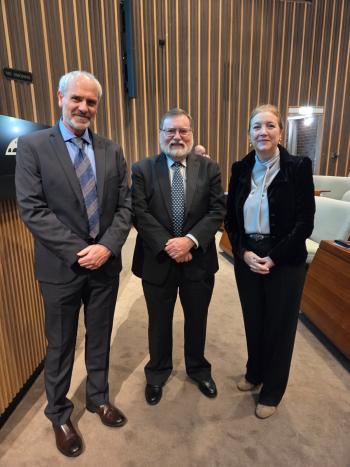
Image (left to right): Dr Josep 'Pep' Canadell, Prof Tony Haymet, Her Excellency Esther Monterrubio Villar.